Veterans and Public Explore Career Opportunities in the Union Construction Trades
November 13, 2026

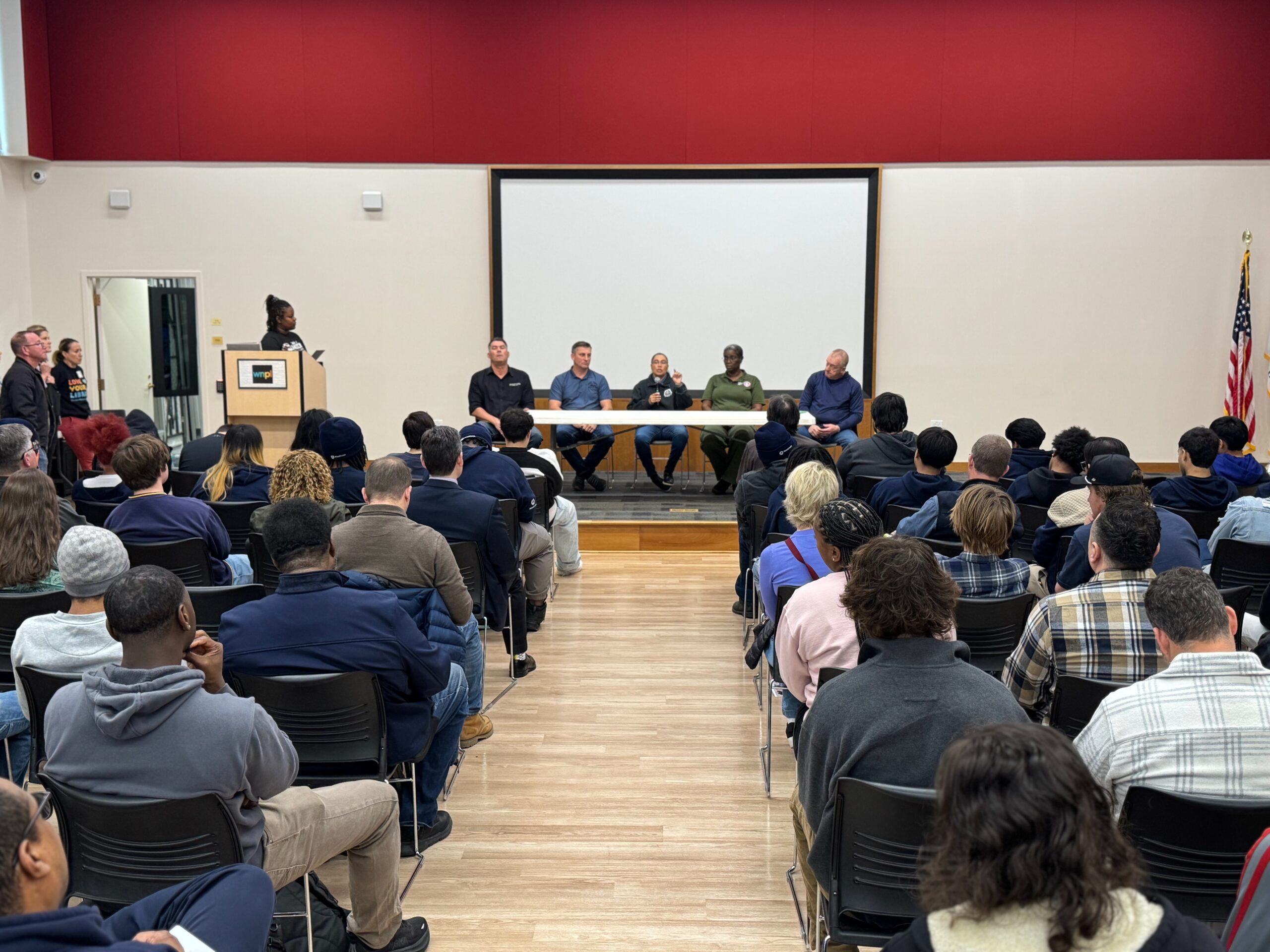
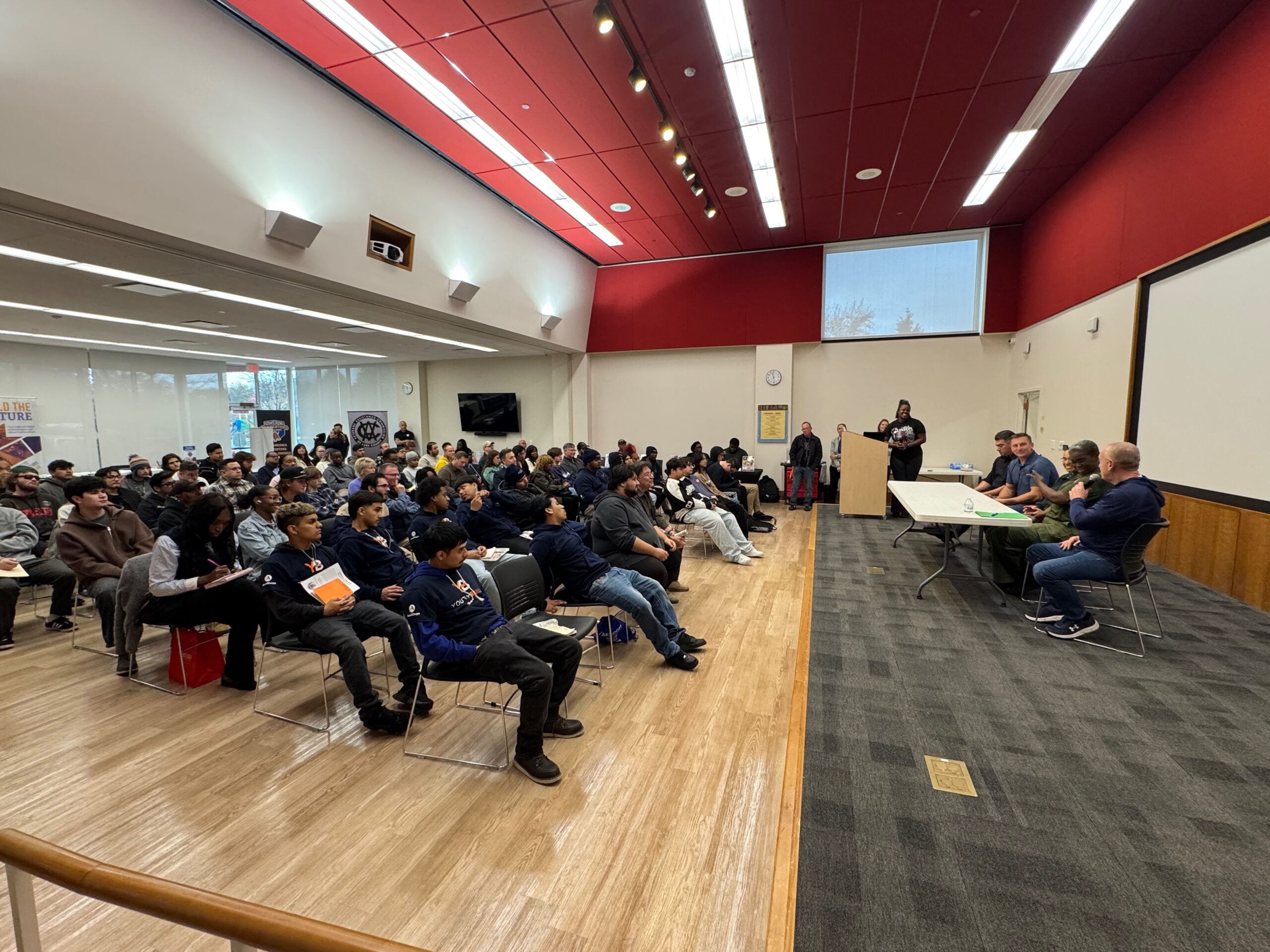
BURR RIDGE – Transitioning from military service to civilian life can open doors to new opportunities. Careers in the Union construction trades offers Veterans a pathway to good-paying jobs, excellent benefits and long-term career stability. During the Nov. 11, 2026, Union Trades 101: Apprenticeships, Careers and Opportunities at the Warren-Newport Public Library in Gurnee, IL, representatives from several Union Apprenticeship and training programs participated in an informative panel discussion, sharing valuable insights into the opportunities available in the construction industry.
Moderated by CISCO Education-to-Careers Director and Assistant Executive Director Jamillah Muhammad, the discussion covered everything from Apprenticeship requirements and earning potential to the skills needed to succeed, resources available to Veterans and advice for those considering a career in the Union trades.
Moderator:
CISCO’s Education to Careers Director and CISCO Assistant Executive Director Jamillah Muhammad
Panelists:
– Pipefitters Local 597 Admissions Director Adam Sutter
– Bricklayers and Allied Craftworkers Apprenticeship Coordinator Mariusz Panocha
– Mid-America Carpenters Regional Council Apprentice & Training Assistant Coordinator Lucia Alvarado
– Indiana, Illinois, Iowa Foundation for Fair Contracting (III FFC) DEI Outreach Associate, and Operating Engineers Local 150 representative Tamara McCollough. An Air Force Veteran.
– Utility Military Assistance Program (UMAP) Instructor Brian Murray
Q: Moderator Jamillah Muhammad:
For someone who has never considered a career in the Union construction trades, can you explain what an Apprenticeship is, and how it differs from traditional college or vocational training?
A: Brian Murray:
An Apprenticeship is something where you work your way up, and learn your way through the process of what you’re doing, whatever industry that may be. And in my industry, it’s the gas industry. We employee utility workers at Peoples Gas.
A: Lucia Alvarado:
When you go to college, you PAY the college to learn your craft. When you go through a Union Apprenticeship program, you GET PAID to learn your craft. When it comes to a trade school, they are non-Union, so you will not be in a Union when you’re done. You will not receive Union pay or benefits and you will have to pay for that skill.
Q: Moderator Jamillah Muhammad:
When we discuss wages, for a first-year Apprentice, it ranges between $18-$26. Then every six (6) months, every few 100 working hours, or every year, you may get raises, and you finish up making between $48-$58 an hour, depending on what trade that you’re in. Can the panel to discuss the benefits that come along with the Union wages?
A: Lucia Alvarado:
The pay in the Union trades is great. The benefits are better. At Mid-America Carpenters Regional Council, the Union contractors pay towards your benefits, which are comprehensive health and wellness benefits. We also have a Vacation Fund, and that benefit comes from the Union contractors. $3 for every hour you work goes into a pot. In June, all the money gets collected. In July, it gets sent out to everyone. We are averaging around $4,000 to $5,000 on that vacation check. Our Union contractors also pay for your training. That’s why Union training is tuition-free, and we give you a stipend for attending your curriculum classes, meaning, you get paid to learn your craft at work, and you get paid to learn your craft at school.
Q: Moderator Jamillah Muhammad:
What are the minimum qualifications for entering an Apprenticeship program? Are there age requirements, education, driver’s license, or testing requirements associated with your particular program?
A: Brian Murray:
Our program is strictly a Veterans program. We’re only looking for Veterans. You don’t have to have any qualifications, however, it’s nice when you do. But our deal is, we teach you to be a utility worker. With Peoples Gas, you can start out at $35 an hour, with medical, dental, eye care, and a very nice 401 (k).
A: Tamara McCollough:
With the Operating Engineers Local 150, you have to be 18 and with a high school diploma or GED. Both things must be true. You will get drug tested. We don’t have an aptitude test for our entry. Instead, we go straight off your application.
A: Lucia Alvarado:
For the Carpenters Union, you must be at least 17 years or older, have a high school diploma or GED, driver’s license or state ID, social security card, and $25 for the application. You must pass an aptitude test, which is basic math and reading. Math portion is 2+2+4. For the reading portion, you read a paragraph, then summarize it. Then you must pass a drug test. All our trades are drug free. And you must supply a physical showing you’re able to do the work with no restrictions.
A: Mariusz Panocha:
The Bricklayers are very similar with requirements. You must be 18 to join the our Pre-Apprenticeship program, have a valid driver license or state ID, birth certificate and $20 application fee.
A: Adam Sutter:
Pipefitters Local 597 takes applications every month. You must be at least 17 years old and a senior in high school to apply. You also have to be on track to graduate high school, so you must get a letter that says you’re on track to graduate, which will be your placeholder for your high school diploma. You must have valid driving privileges, birth certificate, and $20. When you get selected, you will be drug tested.
Q: Moderator Jamillah Muhammad:
What can someone do today to become a competitive applicant?
A: Adam Sutter:
Have the desire, interest, and commitment to be a tradesperson. Having some sort of trade-related background does help separate you from others applicants. This can be welding or HVAC experience that came from a school or work. Any type of trade-related background helps.
A: Mariusz Panocha:
That is the same for the Bricklayers. I’d say the biggest thing is to show up and be on time.
A: Lucia Alvarado:
Having soft skills is what is going to set you apart from everyone else. You need to show up on time, and that means 1/2 hour early. If you start work at 8 a.m. and I show up at 8 a.m., you’re late. Get there at 7:30 a.m. When selecting a Union Trade to go into, select a Trade that you enjoy, and you want to do for the rest of your career. Always show up early, be willing to learn and work hard. Union contractors pay good, but we expect good work in return.
A: Tamara McCollough:
In in addition to what has already been said, you need to follow simple directions, have good listening skills and be teachable. We don’t expect you to know everything. We’re going to teach you what you need to know, but you have to be open minded and willing to learn. Communication skills are also important and you must be safety minded. The Trades are a dangerous industry, so you must be safety minded.
A: Brian Murray:
The Utility Military Assistance Program (UMAP) program I run is an accelerated program. I you miss a little, you miss a lot, meaning we need you there every day and to be early. It’s a big thing. Because we work in the gas industry, you must be safety orientated. There are possibilities of explosions, and we also deal with carbon monoxide, so you must be safety orientated. If you’re not, don’t show up for our industry. (UMAP provides a 6-month, no-cost training program that transitions active-duty personnel, reservists, National Guard members, and veterans into civilian careers in the utility and gas sector, often leading to placement with Peoples Gas in Chicago).
Q: Moderator Jamillah Muhammad:
For our panelists who are Veterans, what inspired you to pursue a career in the Union construction industry after your military service?
A: Tamara McCollough:
I’m an Air Force Veteran and did communications in the military, but my military service didn’t drive me to the Trades. It was my desire to work with my hands. I’m a daddy’s girl, so he did stuff around the house and so did I, like working on cars. That’s how I knew I wanted to work with my hands.
A: Adam Sutter:
I was in the infantry, so I worked with heavy weapons, demolitions, explosives, anti-tank. You can’t use that legally outside military, so my background didn’t push me into the Trades. Instead, I also grew up in a Union family, and my dad was a jack of all trades. I just fell into it. Working with my hands was something that I was familiar with and more comfortable with. I sure wish I would have joined when I was 18.
Q: Moderator Jamillah Muhammad:
What skills or experiences from your military service have helped you succeed in your trade?
A: Adam Sutter:
Work ethic, and showing up on time. That’s it.
A: Tamara McCollough:
Same for me.
Q: Moderator Jamillah Muhammad:
Are there specific pathways or resources available to Veterans, such as Power for America or GI Bill benefits, that can assist with entering or completing an Apprenticeship?
A: Tamara McCollough:
I would say the GI Bill doesn’t help complete an Apprenticeship, but there is a financial benefit as you go through your Apprenticeship. If you’re a Veteran, we look for Helmets to Hardhats on applications. (This program supports a successful transition from military service to civilian careers by providing direct pathways into registered Apprenticeship programs within the construction and infrastructure industries). As a Veteran, provide your Joint Service Transcripts when you apply because that’s one of the areas that we look at. (These transcripts help service members translate military training into civilian academic credit and career credentials).
Q: Moderator Jamillah Muhammad:
What qualities make someone a successful Apprentice?
A: Brian Murray:
You need to have the drive to want a career and to retire from a Union. The Local I’m in, I’ve been there 39 years. The Union allowed me to take care of my family. We had nice vacations, a nice home, a nice car, and that’s all because I choose a career, and I did the right things during my Union career. If you do the right things from the day you start, 10 years later, you’ll be making approximately $60 an hour, but you have to do the right things.
A: Tamara McCollough:
Completing a Pre-Apprenticeship can help get you certifications and a history of showing up on time. A Pre-Apprenticeship can help with your soft skills and exposure to different trades. That looks good on you application when you apply. Understand you may not get accepted into an Apprenticeship the first time you apply. Don’t give up and use that time to get certifications or more certifications. Find employment in a field that will help your application. For instance, Operating Engineers Local 150 has a Diesel Mechanics program, so getting a job at a tire-changing place or oil-changing place can help your application.
Q: Moderator Jamillah Muhammad:
What are some of the biggest misconceptions people have about working in the Union construction Trades?
A: Adam Sutter:
That you only get into a Union if you know someone. The Unions don’t care who you know. YOU have to get into an Apprenticeship. If you do know someone working at the Union, great, but they already got the job. Now YOU have to get the job.
A: Mariusz Panocha:
It makes me laugh when I see comments on social media saying Union workers are lazy. I see that a lot. These people didn’t know nothing about Unions and they don’t know anything about the difficult and dangerous work we do.
A: Tamara McCollough:
There’s a misconception that if I failed in high school or college because I didn’t apply myself, then I can just get into the Union Trades because it’s easy. It’s definitely not easy.
Q: Moderator Jamillah Muhammad:
If you’re an older individual, is it too late to start an Apprenticeship with the Union Trades?
A: Mariusz Panocha:
The Bricklayers don’t discriminate against age. Lately, I’ve been seeing a lot of people coming to us who want to join our Union and they’re in mid 50s. They realize they don’t have a pension plan, or an annuity, and they have to do something so they can retire with money.
A: Lucia Alvarado:
A lot of our Apprentices starting with the Carpenters, this is their second career. For me, this is my second career. I went to college and got my bachelor’s in anthropology. Then realized that doesn’t pay anything. That was when I went into the Trades, and I was around 30 years old.
A: Tamara McCollough:
I started my first trade at age 33, and then I started Operating Engineers Local 150 at age 48. So, you don’t have to start young, but it would help if you did.
A: Brian Murray:
We always emphasize that we do not age discriminate. However, with the industry I’m in, it’s a labor position and the work favors a younger person over an older person. You’re going to be digging ditches. You’re going to be jackhammering, and you’re going to be drilling holes through walls.
Q: Moderator Jamillah Muhammad:
Give one piece of advice for someone who wants to enter the Union construction industry.
A: Brian Murray:
Pick something in the industry you want to do. Going into the Union Trades gives you a career. You’re going to be doing it the rest of your life. Picking a Trade you enjoy is very important.
A: Tamara McCollough:
Be resilient. Just because you get a ‘no’ from the first Union you apply to, doesn’t mean that’s a permanent ‘no.’ That door is not completely closed. Reassess, do what you need to do, go back and reapply. Keep trying.
A: Lucia Alvarado:
The Carpenters Union offers six different programs. (General Carpenters, Concrete Form Builders, Floor Covers, Mill Cabinet, Millwrights and Pile Drivers) You can come into one program, decide you want to do a different discipline, and to into a different program. I came in through the General program, but my curriculum classes were for Residential, and all my field work was in concrete. Within our Trade, you can maneuver your career for where you want to go. You can become a Foreman. You can become a Superintendent. You can also decide you want to become a house carpenter by taking a couple additional classes. All of that is offered in our Union. There is movement within our careers.
A: Mariusz Panocha:
Be open to opportunities. Using myself as an example, I started as a Laborer, then I become a Bricklayer. I work my way up and become a Foreman where I was running multi-million-dollar projects. One day, I got a call from the Bricklayers Training Center, and they offered me a position as an Instructor.
A: Adam Sutter:
What’s going to make you successful in an Apprenticeship is you have to be ready to work. Show up on time. Keep your head down and work. Everything else can be taught. The other stuff are intangibles that you have to bring to the table. Be reliable and have a good attitude.
Audience question:
After the Apprenticeship, will we have credentials?
A: Adam Sutter:
Yes. Every Trade varies, but you’ll earn several industry recognized certifications during your Apprenticeship.
Audience question:
What are the pros and cons of your Trades?
A: Mariusz Panocha:
Pros are it’s pays well and you receive great health benefits. Cons are you have to work hard, and you’re exposed to weather conditions. When it comes to bricklaying, you’re working outside, so you’ll be exposed to extreme hot, and extreme cold.
Audience question:
Why did you guys pick your specific Trades?
A: Tamara McCollough:
In the military, I did more communication type work. It was more electrical work. But that wasn’t my interest. Then I went into sheet metal working, which I enjoyed doing. But operating heavy equipment appealed to me throughout my life. I always wanted to do that. I chose other careers along the way because I didn’t have the knowledge on how to get where it was I wanted to go.
Audience question:
What advice do you have for students who have a different learning style than others?
A: Brian Murray:
Let your instructor know. I deal with this because I’m a trainer. I understand some students excel in different situations. We do a lot of testing. We do 59 tests in our program. Some people test well, and some don’t. Sometimes we’ll test people in a separate room by themselves because they don’t like taking tests with others. You can work it out.
Audience question:
Can you tell us about some of the most common challenges Apprentices face during the application process and in their first year as an Apprentice.
A: Lucia Alvarado:
The Carpenters Union is a Sponsorship Union. That means, before you apply, you have to get a contractor to hire you. That contractor will give you an Intent to Hire letter, which you provide with your application. I think this is the hardest thing to do because you’ll need to network, and you’ll need to be interviewed, and you’ll have to be comfortable doing this.
Audience question:
Are Union meetings virtual?
A: Lucia Alvarado:
They are still in person.
Audience question:
What does a normal day a normal day look like?
A: Tamara McCollough:
In varies because every day is different.
Audience question:
What keeps all of you going, especially when things get tough?
A: Tamara McCollough:
I enjoy what I do. I get paid well for what I do. I receive good benefits for what I do and I have a solid pension for when I retire.
A: Lucia Alvarado:
As Trades people, we have bragging rights to say, “I built that.” I was able to work on the Wrigley Field renovation and I’m really proud of that. It was in the middle of winter. We started in October. We finished in March. We had to complete it before the spring season started. We worked in -20 temperatures, seven days, 12-hour days. But again, I get to brag about working on it.
A: Mariusz Panocha:
When I joined the Union in my mid 20s, I didn’t really care about my pension, or my annuity. Now, that’s what drives me. I want to work even harder because I can see the money growing for my retirement.
A: Adam Sutter:
There are 27 different Union Trades in Chicago. You have to find the one you’re passionate about. If you’re seriously interested in working construction, you need to apply to at least five different Trades. We all get paid similar money, and get similar benefits. You can’t go wrong in any of them, but you have to look 20 years down the line and ask yourself, “Am I going to be happy doing that in 20 years?” 90 percent of life is showing up, 10 percent is putting in work. To be happy, you have to find something you actually enjoy doing.
Audience question:
How weather dependent is your job? Do you work all year long or are there times that you can’t work?
A: Adam Sutter:
Each Trade is different. The Pipefitters is a year-round kind of career so we work during winter.
A: Mariusz Panocha:
You have to be ready for downtime. The Bricklayers are seasonable workers. Certain contractors may work indoors during winter, or they tarp the outside scaffolding you’re working on in winter. When you’re working, you have to be smart with your money.
A: Lucia Alvarado:
The Carpenters offer six different programs, and some of them are seasonal. If you’re doing concrete, you’re definitely going to be off during the winter. If you’re doing flooring, you may also be off during the winter. Learning to manage your money is important. We have financial classes at our Training Center so you can learn to manage your money. When you start your Union career, you are earning a lot of money, and it’s a lot of money in your hands, and you just want to spend. You need to save up for those rainy days. Also, prior to starting a new construction job, the contractor may have to secure a crane permit. It may take a week or a month and during that time, you’re not working.
A: Tamara McCollough:
Operating Engineers is seasonal work. The materials we work with have to be a certain temperature in order for us to work with them. Our Diesel Mechanic program goes year-round because our equipment has to be maintained and repaired.
A: Brian Murray:
At Peoples Gas, and the colder it gets, the more we work. We deal with the gas that goes through the city, so we are 24/7, every day of the year. The colder it gets, the more overtime you get. We are out there in the cold all the time.
A: Lucia Alvarado:
When I have down time during the winter months, I have a list of things I want to get done, so I start working on that list.
A: Tamara McCollough:
Keep in mind, you’re receiving unemployment. You’re not receiving your regular check, but you will receive unemployment. I don’t seek other employment. I managed my money to live within my means during the year.
Audience question:
What is your proudest job you’ve worked on?
A: Brian Murray:
I was sent to New Jersey in 2012 after the devastation of Hurricane Sandy. We helped out after that storm. We were there for about 16 days, working 16 hours a day, seven days a week. That was a great moment in my life to help people who were actually devastated by Hurricane Sandy.
A: Tamara McCollough:
I’m proud of building the Marriott Marquis in Chicago that connects to the Wintrust Arena, where the Chicago Sky plays.
A: Lucia Alvarado:
For me, it was the Wrigley Field renovation project I talked about. But I also helped build two buildings in downtown Chicago, which is so iconic, and these buildings were added to Chicago’s skyline.
A: Mariusz Panocha:
I have quite a few of them because I was involved in restoring state capital buildings across the country. I worked in Minnesota, St. Paul, Wyoming, Philadelphia. So ,I have couple historical project under my belt.
Q: Moderator Jamillah Muhammad:
What advice do you have for women who are looking to break into the Union construction industry?
A: Tamara McCollough:
You can do what it is you want to do. Learn your skill, because that’s where your money comes from. Once you learn your skill, build your confidence with that skill. That’s the key to success. A lot of times, we come into the Trades and we don’t have the confidence we need, or we do a self-comparison. Learn your rights of what can and cannot happen on a job site, and find a community. I have a community with Chicago Women in Trades. That’s where I go to talk about things with other like-minded women. That’s a very important part of my career.
A: Lucia Alvarado:
I agree that you need to find your community. Sometimes you’re going to be the only woman in the job site. Everyone’s going to know your name, but you’re not going to know everyone’s name. Everyone’s going to be watching what you do. Make sure that you show up, you’re doing your work and you have confidence in your work. That’s going to speak louder than anything else. You’re going to have a bad day, so having a community to talk with helps.
Audience question:
Can you talk about the importance of having a reliable vehicle and the importance of having a driver’s license?
A: Tamara McCollough:
Everything does not run around public transportation. For the Operating Engineers, we build roads, so you might be on a jobsite where there is no road – even if there is public transportation that could get you to the jobsite. You just need reliable transportation to get you where you need to go, not a new truck.
A: Brian Murray:
With Peoples Gas, you need a vehicle to get you to and from work. Once you’re at work, you use their vehicles. When it comes to your driver’s license, it is your lifeline because, if you don’t have a driver’s license, you don’t have a job. It has to be valid, and it will be checked yearly. During our six-month program, if you get a DUI or two speeding tickets, you won’t be accepted for the job.
A: Lucia Alvarado:
The Carpenters represent 10 counties, so you need a vehicle to get to the job site. Keep in mind, public transportation doesn’t run really early, which is when you need to be at the jobsite. And Ubers and Lyfts probably won’t want you in their vehicles with all your gear and tools or if you’re dirty and muddy after working.
A: Mariusz Panocha:
Many of our jobsites are in the middle of know where, so public transportation won’t get you there.
A: Adam Sutter:
You can’t apply for the Trades without a valid driver’s license. You also don’t want to rely on somebody else to get you to and from work on time. Most of our work is found in the outskirts of the city limits, so there is no public transportation to get you there.
Audience question:
Do the Trades do background checks for felonies and misdemeanors?
A: Adam Sutter:
The Pipefitters Local does not do a background check when you apply for the Apprenticeship. However, the contractor will. A felony never helps you, but it doesn’t disqualify you. If you have a driving record, a contractor will not let you drive one of their vehicles.
A: Mariusz Panocha:
The Bricklayers won’t discriminate, if you have a criminal record. It will affect your ability to on government jobs, or schools. You might not be eligible to work on those job sites.
A: Lucia Alvarado:
Before you work on power plants, they will do a background check, but to get into the Carpenters Apprenticeship, we don’t check.
A: Tamara McCollough:
Just because you can’t work at a jobsite, doesn’t mean you can’t work for a company. Just not at that particular jobsite.
A: Brian Murray:
With Peoples Gas, your driver’s license is your lifeline because you’re driving a company vehicle. We will do a background check because we need people who can go into customers’ homes.
Audience question:
What upfront costs are associated with these Apprenticeship programs?
A: Brian Murray:
With Peoples Gas, one of the benefits is they give you everything. They give you all your tools. You drive their vehicles. They pay for your boots. They give you all your safety equipment you wear. If you say you don’t have something, you’re in trouble because they give it to you.
A: Tamara McCollough:
If you go into Local 150’s Diesel Mechanic program, you’ll need the basic mechanic tools to work.
A: Lucia Alvarado
With the Carpenters, you just need your basic tools, which is your pouch with your hammer, knife, and tape measure.
A: Mariusz Panocha:
The Bricklayers provides you your hand tools. When you graduate from our Pre-Apprenticeship program, you can leave with about $500 worth of hand tools. You’ll have to buy your work boots.
A: Adam Sutter:
For the Pipefitters, we give you your books, your tools, and your uniforms.

