Project of the Year Feature: Infrastructure
January 15, 2026
BURR RIDGE – CISCO’s 4th 2025 Project of the Year Feature is the top choice of Infrastructure, which is the Red and Purple Modernization Phase One Project. The general contractor was Walsh-Fluor Design Team; the client was Chicago Transit Authority.
When considering submissions, judging criteria is based on: quality of construction, design, impact on the community and safety record.
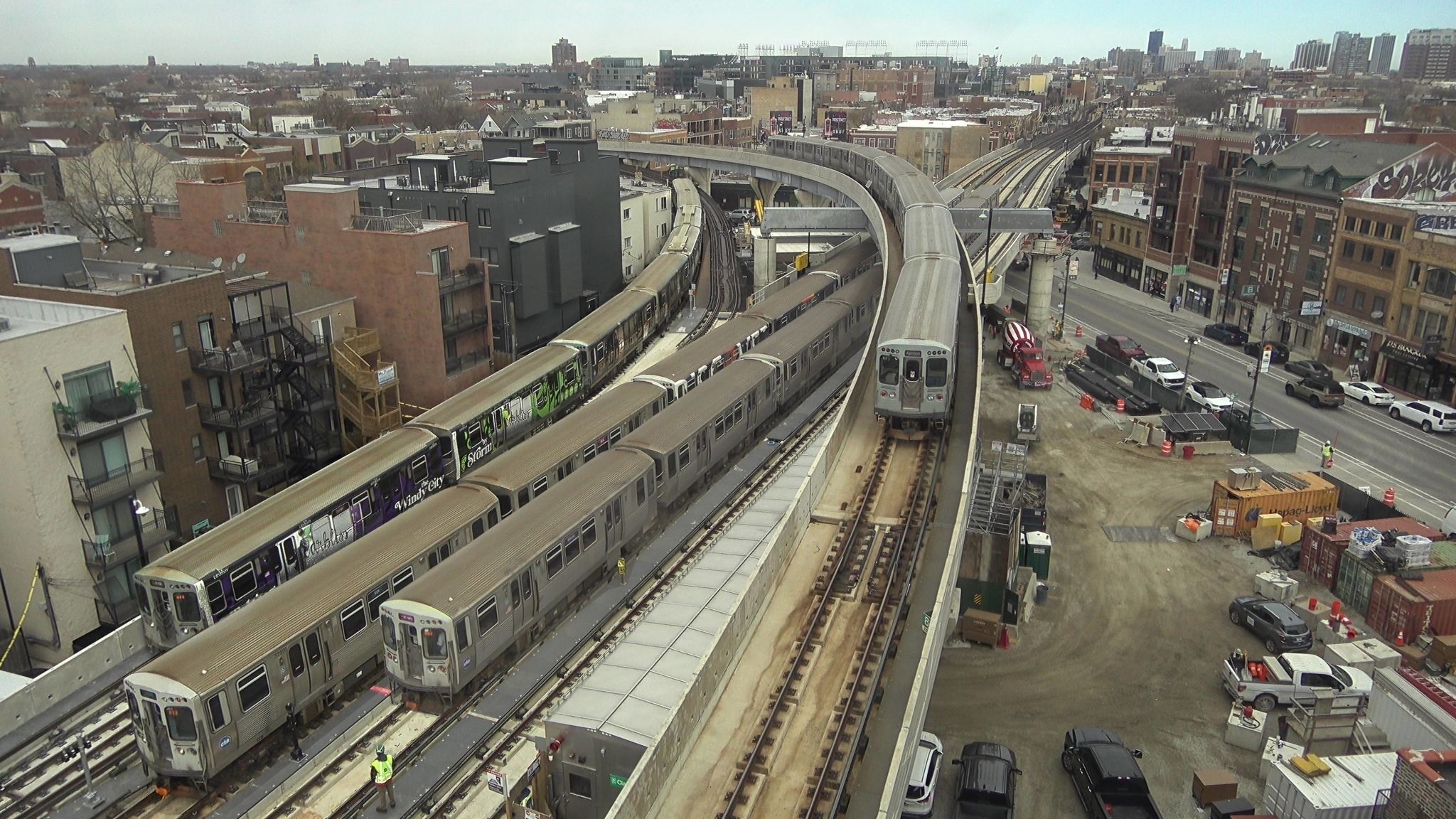
More than a decade ago, the Chicago Transit Authority (CTA) began developing the Red and Purple Modernization (RPM) Program, a massive, multi-phase construction program to rebuild aging infrastructure built in the 1920s on what is the CTA’s busiest rail line — serving nearly 40 million rides annually. In 2018, CTA awarded a contract to Walsh-Fluor Design-Build Team for design and construction work on the first phase of the program, RPM Phase One. The construction of this transformational project continued throughout the COVID-19 pandemic and the new elevated track structures and stations are now done and serving CTA riders.
RPM Phase One is comprised of:
• Red-Purple Bypass: construction of a flyover track for the northbound Brown Line trains north of Belmont that allows trains to travel over four Red & Purple line tracks. The Bypass eliminated a century-old flat junction that limited CTA’s ability to add train service. The work also included the full replacement of the open deck steel structure with a concrete, closed deck structure and straightening speed-restrictive curves, resulting in nearly two miles of new track.
• Lawrence to Bryn Mawr Modernization: reconstruction of the Lawrence, Argyle, Berwyn and Bryn Mawr Red Line stations to provide full ADA accessibility. This also included the reconstruction of the century-old, elevated embankment structure with a modern, precast segmental box girder structure, resulting in roughly six miles of new track, structures, and associated systems infrastructure.
• Corridor Signal Improvements: a new, higher capacity signal system with modern equipment and functionality optimized for the new alignment and infrastructure.
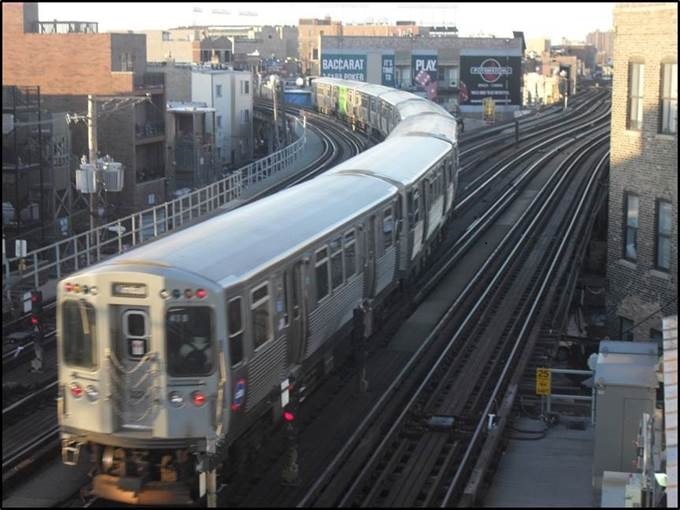
RPM Phase One: Engineering and Construction:
RPM Phase One was an extraordinarily complex engineering and construction challenge like no other in CTA history. CTA understood that for the project to be successful, the agency needed to be creative and open on how best to build it while maintaining critical rail service for Chicago.
To find a qualified contractor team to build the project, CTA undertook an extensive RFQ/RFP procurement process that included that encouraged innovative construction approaches. Ultimately, Walsh-Fluor Design-Build team was awarded the design-build contractor, proposing unique construction methods that reduced construction time and impacts to the densely populated communities – Edgewater, Uptown and Lakeview on Chicago’s North Side. Those included:
• 1,555 precast segmental box girders manufactured offsite to reduce local construction impact
• Using an overhead gantry construction system to install precast segments to build the new elevated track beds
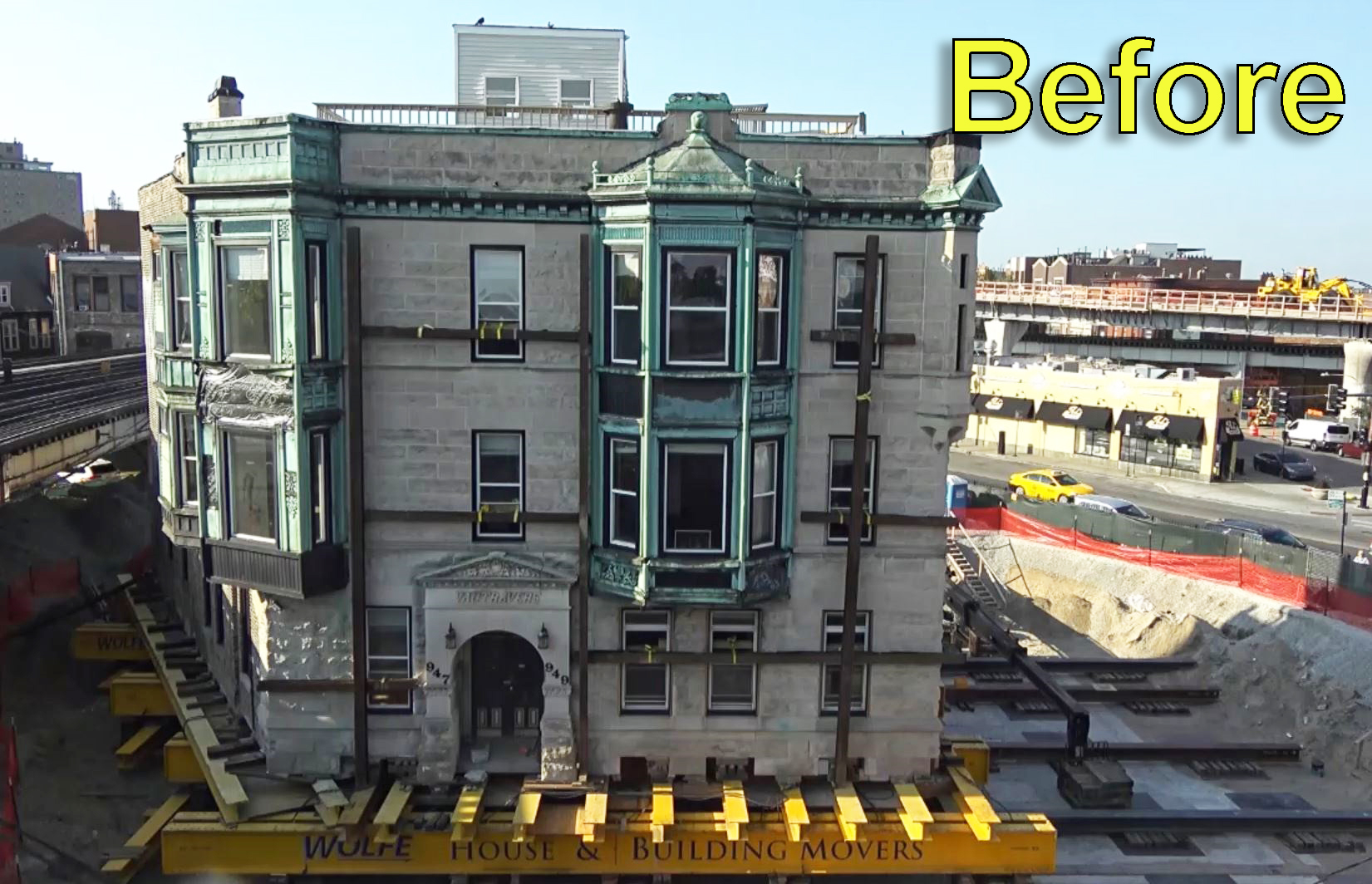
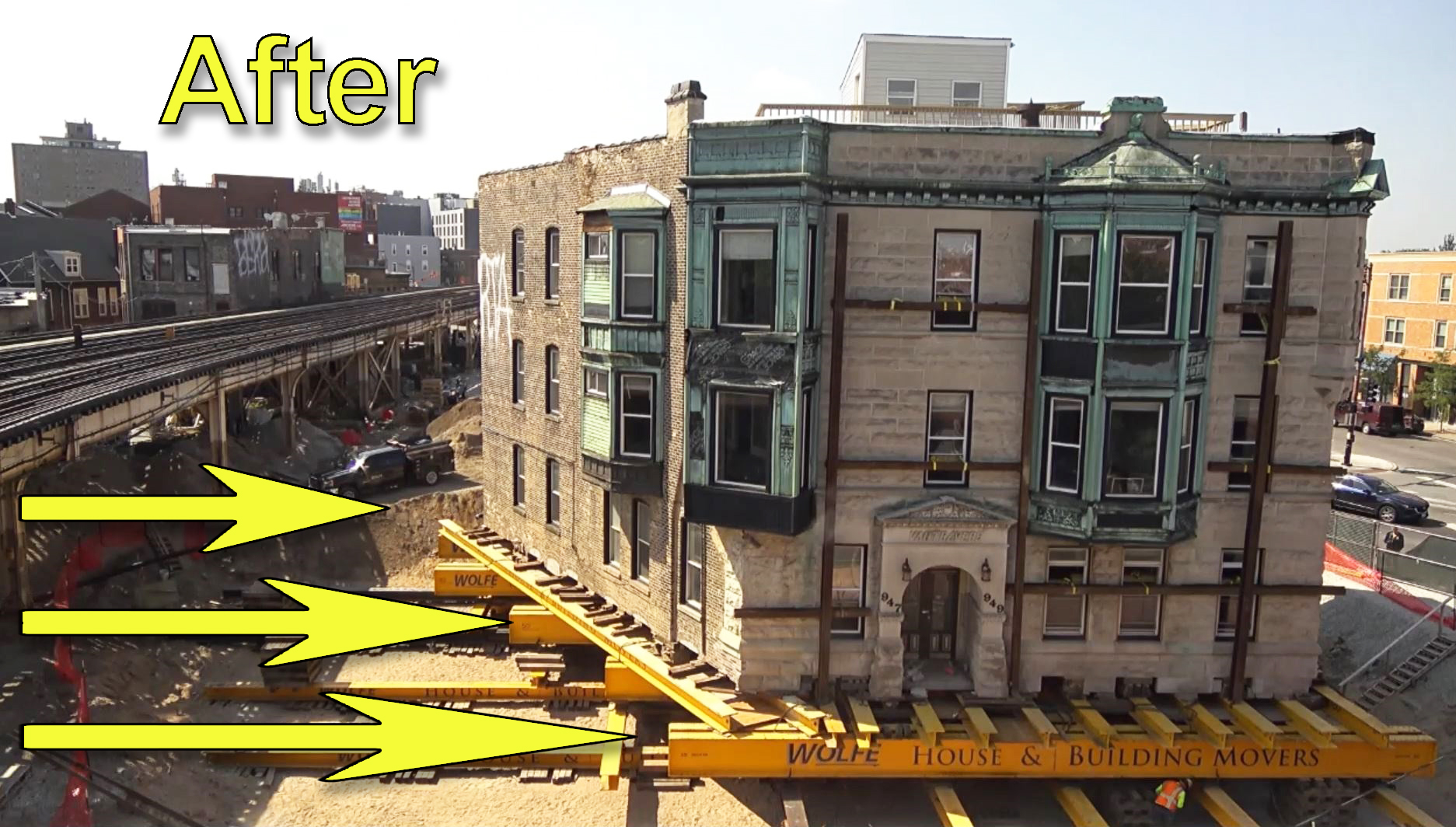
• Relocation of the historic Vautravers residence built in the 1890s on West Newport Avenue to eliminate track curves, resulting in faster track speeds
• Implementation of noise mitigation strategies including sound wall installation and a closed deck, direct fixation track structure.
To continue to provide rail service during reconstruction safely and effectively, the work required multiple train reroutes and track reconfigurations – both in the Red-Purple Bypass area north of Belmont station, where Red, Purple and Brown lines converge; and in the Lawrence to Bryn Mawr section of Red and Purple line track.
Red-Purple Bypass
In this component of the RPM Phase One Project, CTA built a new 0.6-mile rail overpass and then reconstructed underlying century-old tracks in multiple stages.
• CTA built a new rail overpass north of Belmont station 2019-21, which dramatically reconfigured a 107-year-old flat rail junction where Red, Purple and Brown line trains converged. The bypass now carries Kimball (north) bound Brown Line trains over Red & Purple line tracks. The benefits include trains no longer having to stop and wait for other trains to cross; and increasing CTA’s capacity to add rail service.
• After putting the bypass into service in 2021, CTA in two stages reconstructed about a mile section of northbound and southbound Red & Purple line tracks between Belmont and Addison stations.
• The Red and Purple line track needed to be straightened to remove a curve that slowed train speeds, requiring CTA to successfully move a historic residential building in Lakeview 30 feet to the west to allow for reconstruction and track straightening.
• Track construction required multiple staging because of Loop-bound Brown Line trains merging with Purple Line trains north of Belmont and other complexities. To accommodate rebuilding that section of track, CTA built a full-service temporary track to the west to service southbound Brown Line trains during construction. The track has since been demolished.
Lawrence to Bryn Mawr
In multiple stages, CTA rebuilt 1.3 miles of century-old track that included four non-accessible rail stations.
• Four tracks (two southbound for Red and Purple each, two northbound Red and Purple) were reconstructed in two stages, Stage A (2021-23) and Stage B (2023-25). Two tracks were taken out of service in each stage, with rail traffic running on the two tracks not under construction.
• CTA constructed temporary Red Line stations at Bryn Mawr and Argyle for Stage A and new temporary stations for Stage B to provide Red Line access for customers between 2021-25. The temporary Red Line stations were designed with a cheery red exterior to be more attractive to customers and residents. The temporary stations won several architectural awards.
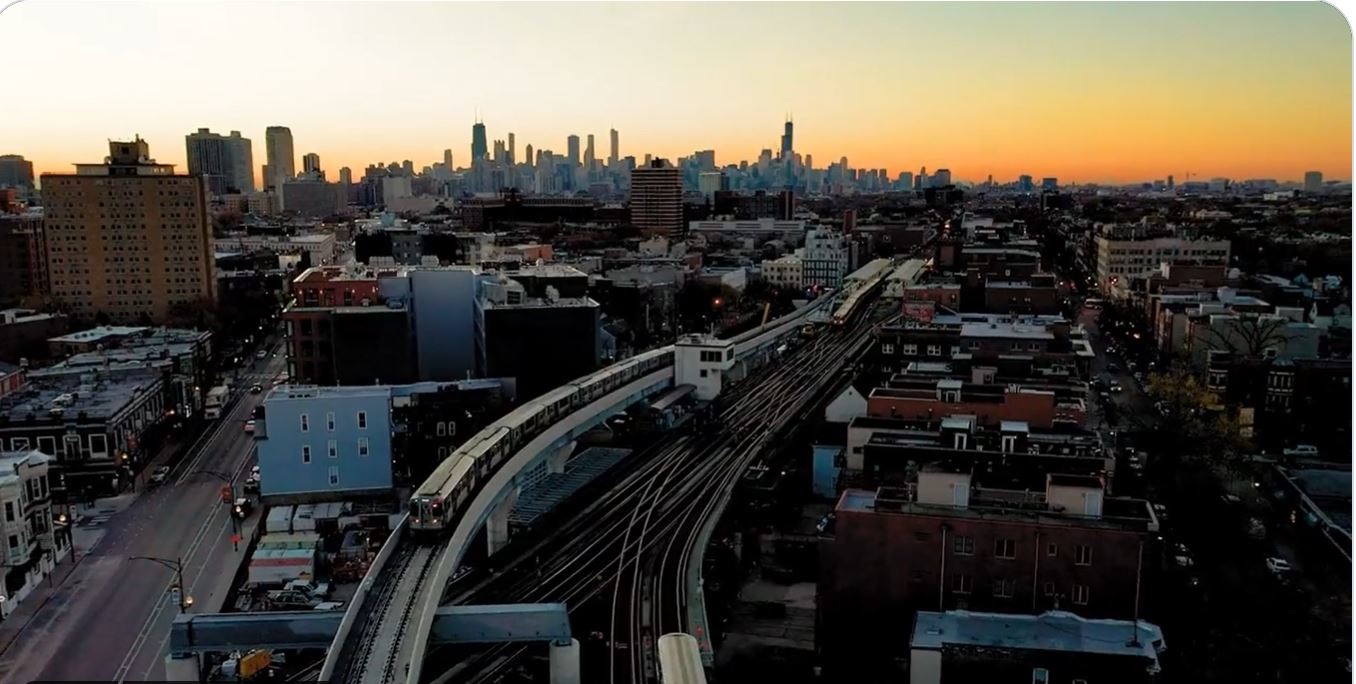
• CTA installed a new “middle track” near Argyle to allow CTA to stage extra trains for busier-than-normal periods such as baseball games and entertainment events, improving service for customers.
• Like the Red-Purple Bypass project, construction in this part of the project required multiple staging before and during construction.
RPM and Architecture
With the construction of new track and Red Line stations, the CTA sought to build structures that were functional but also aesthetically pleasing for the people living, working and visiting the community.
New Red Line stations – Bryn Mawr, Berwyn, Argyle and Lawrence
The CTA with its contractors looked for influences in each of the four station areas to design stations that reflected neighborhood character. Three stations also had some version of historic designation that influenced the design work, and all stations had to be designed for restricted spaces, given the proximity to businesses and residential buildings. All of the main stationhouses feature glazed terracotta cladding for a bright, clean look. Entrances have abundant glazing, providing profuse natural light and enhanced views into and out of the stationhouses.
• Bryn Mawr station is located in a historic neighborhood with unique architecture that includes buildings with preserved ornamental design, color and glazed terracotta. The station was designed to fit in with that, and to include the historic columns that had been a part of the original station’s entrance.
• Berwyn station is flanked by large scale commercial activity to the west and a quiet tree-lined residential zone to the east. The station design reconciles these two conditions by orienting the entrance toward the west. The entry is celebrated with a dramatic cantilevered roof and centerpiece column ringed by a radial lighting pattern to welcome CTA riders.
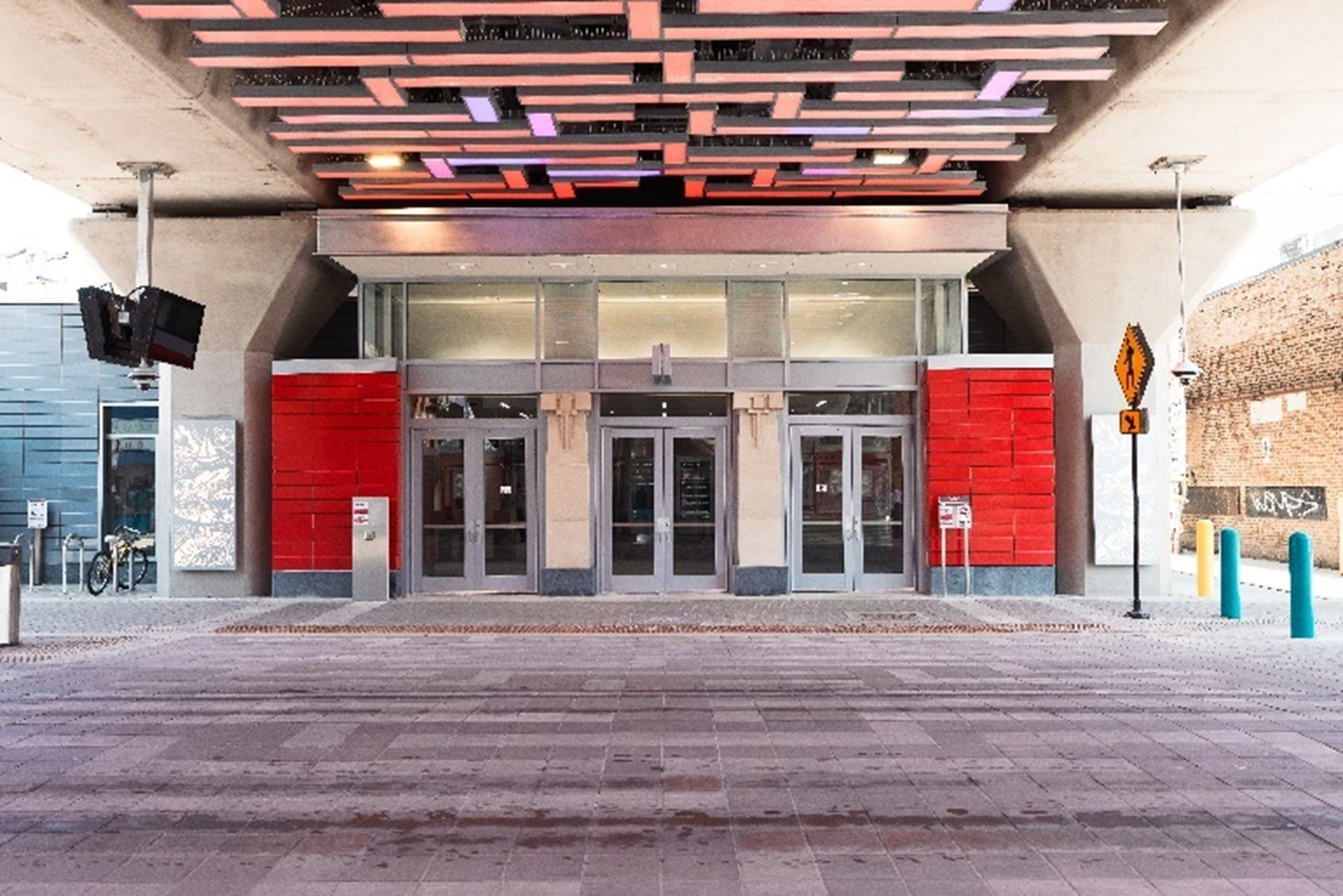
• Argyle station responds to the dynamic and thriving businesses that line the street and form a truly civic space that is the hub of the largely Asian community. The station is clad in red terracotta, a color representing good luck and prosperity in some Asian cultures. The underside of the track structure is animated by a Tetris-patterned light feature that is mirrored on the street paving below. Together with the stationhouse facades they form an outdoor room as a focal point along the street.
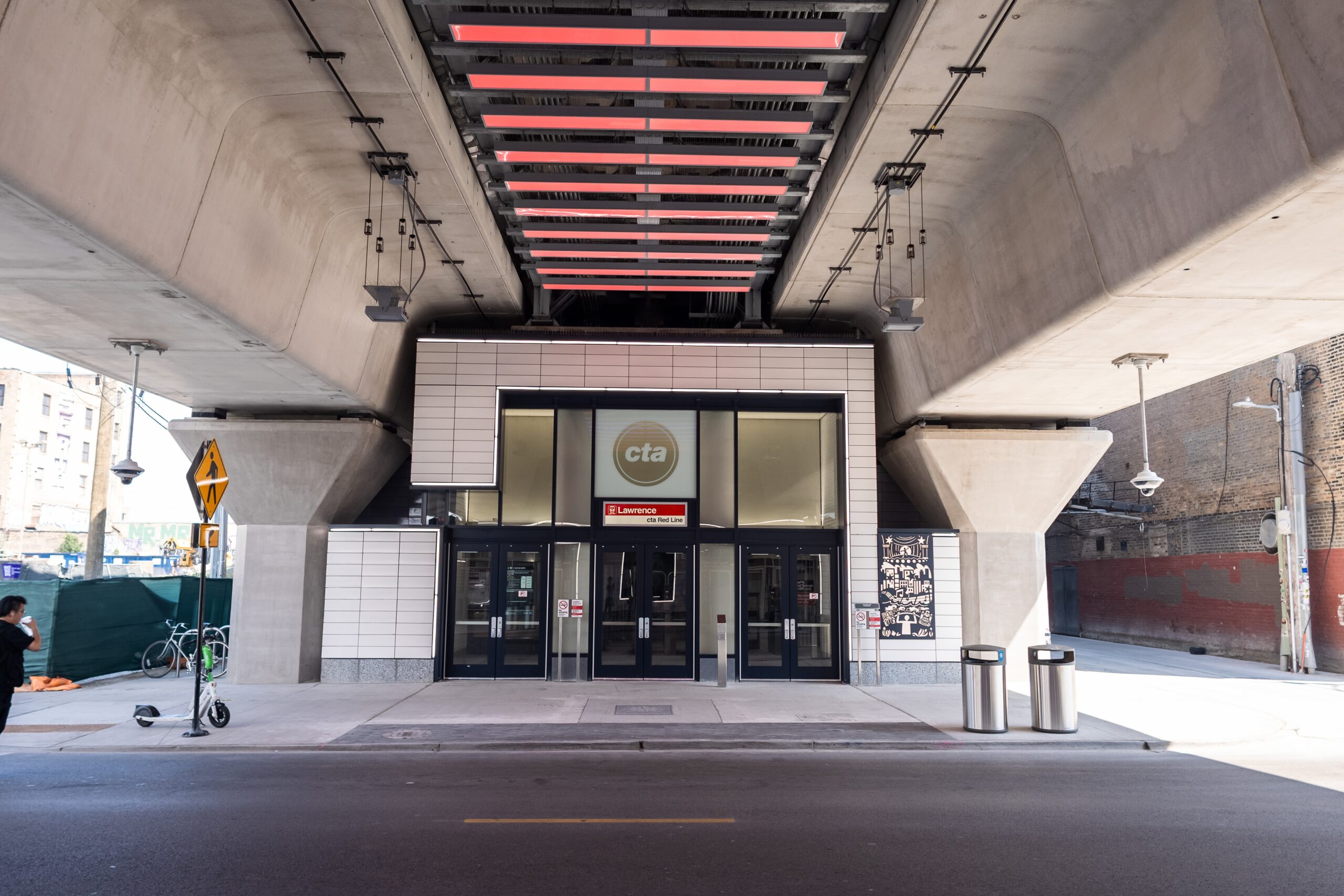
• Lawrence station is located in one of Chicago’s many Landmark Districts and is known for its variety of architectural styles and for popular entertainment venues and destinations. The main stationhouse includes an asymmetrical façade to reflect music and movement, with a touch of drama provided by thin, LED lighting tracing the station entrances. Lawrence also features programmable panel lighting over the street to increase the station’s vibrancy.
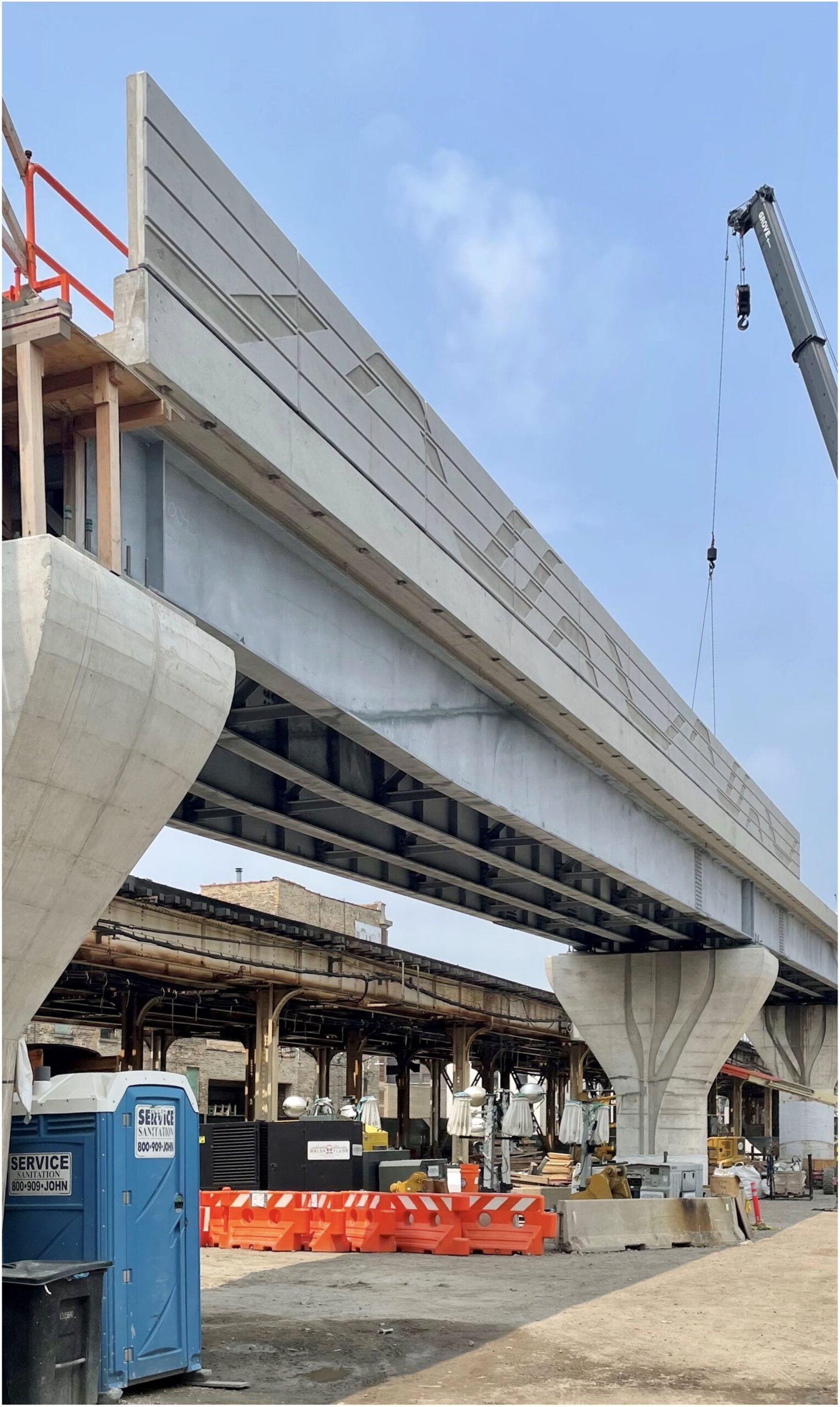
New CTA elevated track structures
At the beginning of RPM, CTA heard from neighbors in the Red-Purple Bypass area concerns about replacing the century-old steel structure with concrete track structure would make the neighborhood look like a “freeway”. In response, CTA worked with its contractors to design and build new track columns that were tulip-like in shape and feature a design to soften their appearance. The CTA provided decorative touches to the noise walls along the tracks in both the Red-Purple Bypass and Lawrence-to-Bryn Mawr areas.
Safety
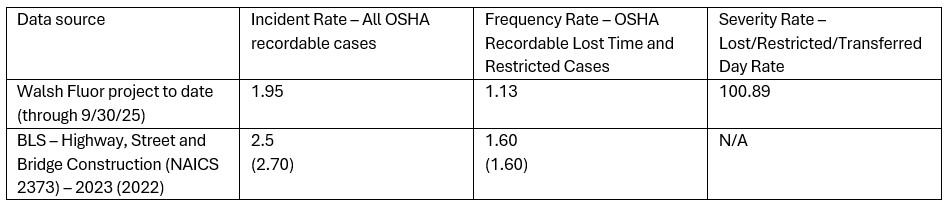
To date on the RPM project, the incident and frequency rate of recordable safety incidents remain well below the national average – per the Bureau of Labor Statistics (BLS) Highway, Street and Bridge Construction data.
RPM Phase One Project Impact
One of the most exciting aspects of RPM has been how it has positively touched many lives beyond riders:
• Small contractors: The RPM Project awarded $294 million worth of contracts to 114 unique small businesses certified as Disadvantage Business Enterprises (DBE). Of those, 53 firms were brand new to CTA.
• Workforce: The RPM Project created 2,979 construction trade labor jobs that paid more than $167 million in wages to disadvantaged workers who qualified under WIOA; lived in Economically Disadvantaged Areas (EDAs) with median incomes under $40K; and first-time trade apprentices who learned skills that build careers.
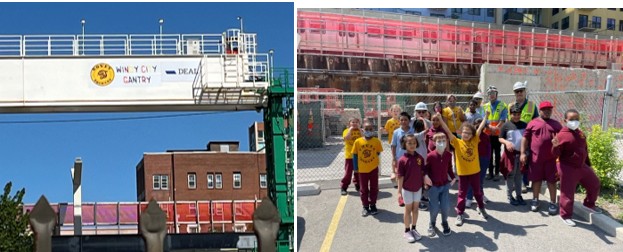
• Children: CTA and Walsh-Fluor launched “Elevating Futures” scholarship program that awarded $250,000 of college scholarships to 10 students from disadvantaged communities. Separately, CTA engaged elementary students by holding a “Name the Gantry” contest. The winning entry, Windy City Gantry, resulted in a pizza party for the winning class and the affixation of a giant Windy City Gantry and Goudy Elementary decal on the gantry system.
• Small businesses: With hundreds of small businesses located in the RPM Project area, CTA offered a popular and free Open for Business program that supported more than 200 businesses during construction. Local participating businesses earned free videography and photography to promote their businesses, callouts on banners and ads on trains and buses, reels on social media and more.